
Jacobian conjecture, Claude Fable and a world-class mathematician
On Sunday night, while most of the world was watching the World Cup 2026 final, an 87-year-old mathematical conjecture died.
The Jacobian conjecture, stated by Ott-Heinrich Keller in 1939 with roots going back to an 1884 paper by Ludwig Kraus, was one of the central open problems in algebraic geometry. Problem 16 on Stephen Smale’s list of mathematical problems for the 21st century. It is famous for two things: being simple enough to state to anyone who knows calculus and for the graveyard of published “proofs” that all turned out to contain subtle errors. For over eight decades, some of the best mathematicians alive tried and failed.
Then, on 20th July 2026, Levent Alpöge posted a polynomial map on X. Three variables, constant Jacobian determinant of −2 and three distinct points land on the same output. Non-injective and not invertible. Result is that the conjecture was shown false.
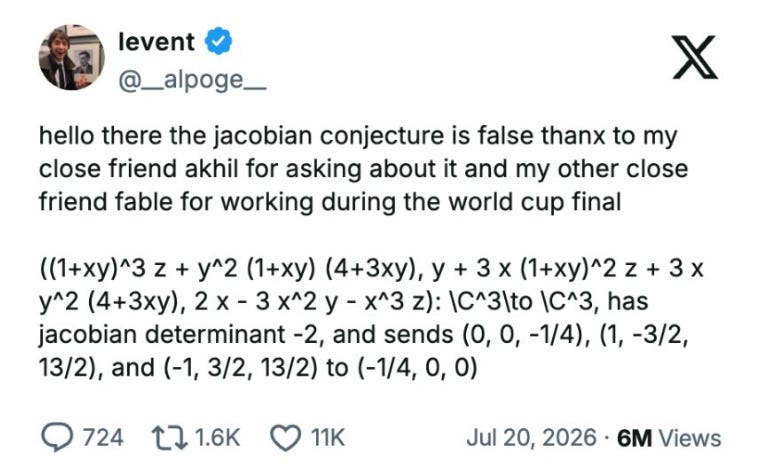
According to Alpöge himself, the counterexample was generated by Claude Fable 5.
Now, two narratives immediately occurred after this breaking math news:
Narrative 1:
“AI just solved an 87-year-old open problem. Mathematicians are obsolete. Everyone is obsolete.”
Narrative 2:
“It’s a stochastic parrot doing matrix multiplication. It got lucky. This means nothing.”
Both narratives are wrong and they are wrong in the same way. They erase the most important person in the story.
Who was actually at the keyboard
Levent Alpöge is not “a guy with a Claude subscription”. He is a world-class mathematician, who won the Morgan Prize (the award for the best mathematical research done by an undergraduate in America). His Princeton PhD work was in arithmetic geometry. In 2025 he co-authored the resolution of Hilbert’s tenth problem over rings of integers of number fields (a problem posed in 1900). He was a Junior Fellow at Harvard.
Then Alpöge decided to join Anthropic and to work on frontier models. So, the configuration that killed the Jacobian conjecture was not “a model”.
It was a world-class mathematician, working in a frontier lab, prompted by a question from another world-class mathematician (Akhil Mathew asked about the problem), working with the best model available with the depth to recognize a real answer when he saw one.
Alpöge described how it happened - the counterexample emerged from what he called the model “ideating about a bunch of random stuff.”
Random stuff is what generators produce, results are what humans filter
A reasoning model exploring a hard problem produces a bunch of random stuff. Wide, nonlinear search across a space of ideas. Most of it is noise. Some of it is nonsense that looks plausible and occasionally there is a candidate that might actually prove or close things.
The AI models are the generators. The frontier models are phenomenal generators, better than anything we have ever built. But a generator without a filter produces noise at scale.
Now, let’s see what the human filter did in this story:
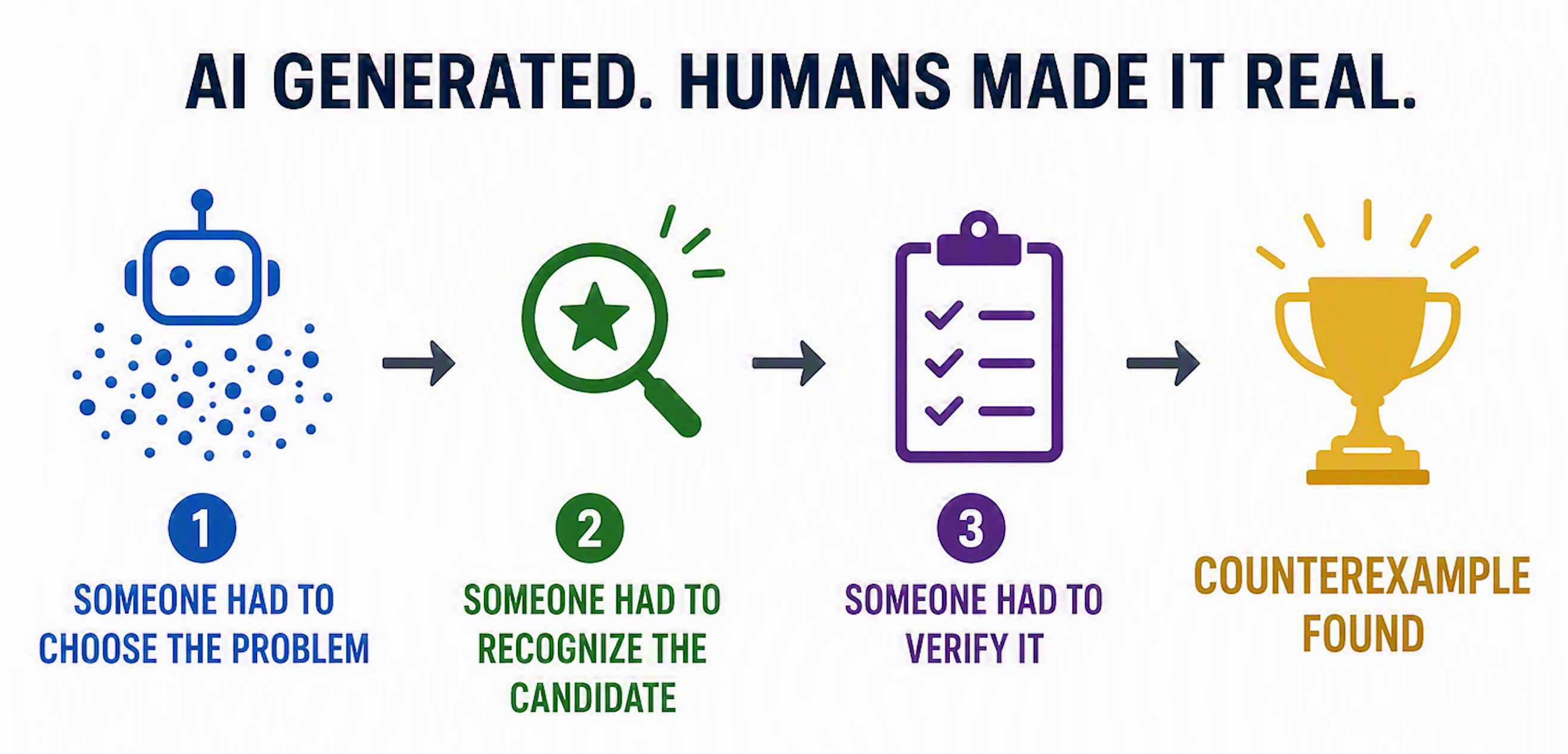
Someone had to choose the problem
This is the part almost everyone misses. The Jacobian conjecture could plausibly fall to a counterexample: a concrete object you can write down and verify by direct computation. That makes it a fundamentally different target than, say, the Riemann hypothesis, which requires a proof, a different class of artifact and one that today’s models cannot produce for problems of that depth. Knowing which type of result is within a model’s reach, on which problem, is itself deep expertise. Alpöge didn’t point the model at a random famous problem. He pointed it at one where the achievable artifact matched the model’s actual capability.
Someone had to recognize the candidate
In a stream of “random stuff,” a specific polynomial map in three variables does not announce itself as historic. To a non-expert it would look like every other line of algebra the model produced. Recognizing that this one might close required an experienced eye, ideally one built over fifteen years of doing mathematics at the highest level.
Someone had to verify it
The Jacobian conjecture’s graveyard is full of proofs, long chains of reasoning where errors hide in subtle places. A counterexample is the opposite: verification is arithmetic. Compute the Jacobian determinant symbolically and it comes out to a constant −2. Substitute three points (0, 0, −1/4), (1, −3/2, 13/2), (−1, 3/2, 13/2) and they map to (−1/4, 0, 0). Non-injective map, constant nonzero Jacobian, conjecture false. I ran the check myself in SymPy because when you know the points, it takes seconds.
Knowing that this check suffices, and what it means, is pure and high level mathematics, not prompting.
Why I’m writing about this on a Substack about enterprise Agentic AI
The dominant enterprise AI narrative right now is Narrative 1 from above, dressed in procurement language: buy the best model, roll out the copilots, deploy the agents, and results will follow. The model will solve it.
Enterprise processes are not the Jacobian conjecture, but the structure of the problem is identical. An agent operating inside your order-to-cash process, claims handling, customer service dispatch, is a generator. It will propose actions. The questions that decide whether this creates value or damage are the filter questions:
Who chose which process the agent operates on and whether it was the right one?
Who defined what a correct outcome looks like?
Who can verify that what the agent produced actually closes and catch the plausible-looking nonsense before it hits a customer or a ledger?
Those questions are not answered by a model.
They are answered by people who have spent years inside the process - who know where the bodies are buried in your CRM data, why the exception path exists for customers with gold status, or who decides on the outcomes.
Process depth is to enterprise AI what Alpöge’s 15 years in arithmetic geometry were to Sunday night - the difference between random stuff and a result.
This is why I keep repeating that agentic AI is a process engineering discipline, not a licensing exercise or a model thing.
The organizations that will capture value are not the ones with the most seats and best models. They are the ones that pair frontier generators with the deepest domain filters and treat the filter as the scarce asset, because it is.
Processes before prompts. Filters before generators. Always.
IMPORTANT NOTES:
The result is days old at the time of writing. There is no paper and no peer review yet, although the verification is elementary enough that multiple mathematicians have independently confirmed the computation.
Precision matters - the counterexample kills the conjecture in three variables and above. The original two-variable case, the one Kraus actually wrote down in 1884, remains open.